
Contents:
- Latest situation
- All bird flu cases and disease zones
- Bird flu guidance
- Bird gatherings
- Vaccines
- Latest GOV.UK news stories
- Risk levels and outbreak assessments
- Wild birds
- Mammals
- Bird flu webinars
- Defra policies and contingency plans
- Bird flu legislation
Take action to prevent bird flu and stop it spreading. Be vigilant for signs of disease and report it to keep your birds safe.
Check what zone you’re in on the bird flu disease zone map.
You must:
- follow the rules for that zone
- check if you need a licence to move poultry, poultry by-products, eggs, material or mammals
Latest situation
10 January 2026
Following successful completion of disease control activities and surveillance in the zone around a premises near Alford, East Lindsey. Lincolnshire (AIV 2025/92), the protection zone has ended and the area that formed it becomes part of the surveillance zone.
9 January 2026
Highly pathogenic avian influenza (HPAI) H5N1 was confirmed in a small backyard flock of other captive birds near Grassington, North Yorkshire, Yorkshire (AIV 2026/03).
A 3km captive bird (monitoring) controlled zone has been declared around the premises. All affected birds on the premises will be humanely culled.
8 January 2026
Highly pathogenic avian influenza (HPAI) H5N1 was confirmed in commercial poultry at a third premises near Newark-on-Trent, Newark and Sherwood, Nottinghamshire (AIV 2026/02) on 8 January 2026. A 3km protection zone and 10km surveillance zone has been declared around the premises. All poultry on the premises will be humanely culled.
Following successful completion of disease control activities and surveillance within the zone around a premises near Gosforth, Cumberland, Cumbria (AIV 2025/98) the Captive Bird (Monitoring) Controlled Zone has been revoked.
7 January 2026
Following successful completion of disease control activities and surveillance in the zone around a premises near Poringland, South Norfolk, Norfolk (AIV 2025/99), the protection zone has ended and the area that formed it becomes part of the surveillance zone.
6 January - further update
Following successful completion of disease control activities and surveillance in the zone surrounding a premises near Corby Glen, South Kesteven, Lincolnshire (AIV 2025/87), the protection zone has ended, and surveillance zone has been revoked at the same time.
6 January 2026
The chief veterinary officer (CVO) for Scotland confirmed the presence of highly pathogenic avian influenza (HPAI) in a commercial backyard flock of poultry on 5 January 2026 at a premises near Blairgowrie, Perth and Kinross, Scotland (AIV 2026/001).
A 3km protection zone and 10km surveillance zone has been declared around the premises. All poultry on the premises will be humanely culled.
4 January 2026
Following successful completion of disease control activities and surveillance in the zone around a premises near Hallow, Malvern Hills, Worcestershire (AIV 2025/94) the 3km protection zone has ended and the area that formed it becomes part of the 10km surveillance zone.
2 January 2026 – further update
Following successful completion of disease control activities and surveillance in the zone around a premises near Attleborough, Breckland, Norfolk (AIV 2025/91) the 3km protection zone has ended and the area that formed it becomes part of the 10km surveillance zone.
2 January 2026
Following successful completion of disease control activities and surveillance in the zone around a premises near Welshpool, Powys in Wales (AIV 2025/95), the CVO for Wales has confirmed that the surveillance zone has ended. The part of the 10km surveillance zone extending into England has been revoked.
AIPZ housing measures in England from 6 November 2025 and Wales from 13 November 2025
Great Britain (England, Scotland and Wales) is in an avian influenza prevention zone (AIPZ). By law you must follow strict biosecurity and hygiene rules to prevent bird flu and stop it spreading.
In the AIPZ in England and Wales there are mandatory housing measures which mean you may have to house your birds.
If you have 50 or more birds you must house them. This applies to all types of birds.
If you keep less than 50 birds and they are for your own use only (for example you do not sell or give away their eggs or meat), you do not have to house them.
If you keep less than 50 birds but you do sell or give away their eggs, poultry products or live birds, you must house them. These birds are known as ‘poultry’.
You can read more information on the requirements for certain types of bird in the declaration for the:
All bird flu cases and disease control zones
The first case of HPAI H5N1 of the 2025 to 2026 outbreak season was confirmed in:
- England on 11 October 2025
- Scotland on 12 November 2025
- Wales on 25 October 2025
- Northern Ireland on 9 October 2025
In line with World Organisation for Animal Health (WOAH) rules, the UK is no longer free from highly pathogenic avian influenza (bird flu).
Find details of all bird flu cases and disease zones in England.
2025 to 2026: summary of confirmed cases in the UK
| HPAI H5N1 cases | |
|---|---|
| England | 68 |
| Scotland | 5 |
| Wales | 7 |
| Northern Ireland | 4 |
| Total | 84 |
Previous outbreak seasons: summary of confirmed cases in the UK
The season is recorded from 1 October to 30 September each year.
| Outbreak season | HPAI cases | LPAI cases |
|---|---|---|
| 2024 to 2025 | 82 | 1 |
| 2023 to 2024 | 6 | 0 |
| 2022 to 2023 | 207 | 1 |
| 2021 to 2022 | 158 | 0 |
Find details of previous bird flu cases and disease zones in England.
Find details of previous bird flu cases in Scotland, cases in Wales and cases in Northern Ireland.
Find details and assessments of past outbreaks in Great Britain in the Animal and Plant Health Agency’s outbreak epidemiology reports.
Bird flu guidance
Find out how to:
- spot and report bird flu in poultry and other captive birds
- report dead wild birds
- prevent bird flu and stop it spreading
- follow the rules in disease zones
- check if you need a movement licence and how to apply
- house your birds safely
- follow the rules if you keep racing pigeons, birds of prey and other captive birds
- hold a bird gathering
You can read guidance about:
- how to keep other pets safe from bird flu, such as cats and dogs
- how bird flu spreads in wild birds and wild mammals, and how the government monitors it
- avian influenza (bird flu) vaccination
Bird gatherings
If you are not in a disease control zone (such as a protection zone or surveillance zone) in England you can:
- follow the conditions in the general licence to hold a gathering of psittaciformes, birds of prey and racing pigeons
- apply for a specific licence to hold a gathering of galliformes, anseriformes, passeriformes, columbiformes (excluding racing pigeons) and ratites
Read guidance on holding bird gatherings in England.
Vaccines
You cannot vaccinate poultry or most captive birds against bird flu in England.
You can only vaccinate zoo birds in England if you meet eligibility criteria and get authorisation from APHA. Only zoos or collections holding a current zoo licence can apply for vaccination.
Defra continues to invest in bird flu research and monitors the situation globally.
We work with the Veterinary Medicines Directorate (VMD) to monitor the development of vaccines for birds.
Find out more information on avian influenza (bird flu) vaccination and the work of the avian influenza vaccination taskforce.
Latest GOV.UK news stories
- National Housing Order declared to protect poultry from Avian Influenza
- Housing measures introduced to protect poultry and other captive birds
- Avian Influenza Housing Measures Extended
- Poultry Meat Marketing Regulations to be amended to support industry through bird flu outbreaks
Risk levels and outbreak assessments
The risk of HPAI H5 in wild birds in Great Britain is assessed as very high (event occurs almost certainly).
The risk of poultry exposure to HPAI H5 in Great Britain is assessed as:
- high (event occurs very often) (with medium uncertainty) where there is suboptimal or poor biosecurity
- medium (event occurs regularly) (with high uncertainty) where stringent biosecurity is consistently applied at all times
Find details of the evidence that supported these decisions in the:
- risk and outbreak assessments
- outbreak epidemiology reports
- weekly reports of findings of bird flu in wild birds in Great Britain
- findings of bird flu in non-avian wildlife
- findings of bird flu in captive mammals
The UK Health Security Agency (UKHSA) advise that bird flu is primarily a disease of birds and the risk to the general public’s health is very low.
The Food Standards Agency (FSA) has said bird flu poses a very low food safety risk for UK consumers. Properly cooked poultry and poultry products, including eggs, are safe to eat.
Wild birds
Find out how to report dead wild birds.
Defra?has set out practical information to support land managers, the public and ornithological and environmental organisations in their response to the growing threat of bird flu.
The mitigation strategy for avian influenza in wild birds in England and Wales explains how these groups, together with the government and its delivery partners, can reduce the impact on wild bird populations whilst protecting public health, the wider environment and the rural economy.
Landowners, local authorities and other organisations can download and print bird flu posters to display on site when there is a risk of bird flu or if bird flu has been detected in the area.
Check the:
- interactive map of reported wild bird mortality and findings of bird flu in wild birds in Great Britain
- interactive dashboard of findings of bird flu in wild birds in Great Britain
- weekly reports of HPAI findings in wild birds in Great Britain
You can find out more about:
- the collection thresholds for dead wild birds with suspected bird flu
- how bird flu spreads in wild birds and wild mammals, and how the government monitors it
Feeding wild birds
You can feed wild birds but always wash your hands with soap and water afterwards. Avoid areas that have premises where poultry or captive birds are kept. Wild birds can spread bird flu to captive birds.
If you’re in an avian influenza prevention zone (AIPZ) you cannot feed wild gamebirds within 500m of a premises with more than 500 poultry or captive birds. Check if you’re in a zone on the bird flu zone map and find out more in the guidance on rules if you keep game birds.
If you feed wild birds in your garden, read advice from the British Trust for Ornithology (BTO) to keep feeders and water baths clean. This will help to stop bird flu and other diseases spreading between different birds.
The UK Health Security Agency has said that the risk to the public from this bird flu strain is very low. It mainly affects birds.
Do not touch or move any dead or sick wild birds – find out how to report them.
Wash your hands thoroughly with soap and water if you touch wild bird faeces or feathers. For more advice go to the NHS website.
Mammals
Avian influenza (bird flu) viruses can also infect wild and kept mammals. This is known as influenza of avian origin.
Find out how we monitor the risk of influenza of avian origin in wild mammals.
Check the:
- report of findings of influenza of avian origin in non-avian wildlife
- interactive map showing findings of influenza of avian origin in wild mammals in Great Britain
- findings of influenza of avian origin in captive mammals
Influenza of avian origin in mammals is notifiable in both wild and kept mammals.
You must report it immediately if you examine or inspect any wild or kept mammal, or analyse samples from any wild or kept mammal or mammal carcase and:
- suspect the presence of influenza of avian origin
- detect evidence of influenza A virus or antibodies to influenza A virus
Report it immediately by calling:
- 03000 200 301 if you’re in England
- 03003 038 268 if you’re in Wales
- your local?Field Services Office?if you’re in Scotland
If you do not report it, you’re breaking the law.
Bird flu webinars
Whether you have pet birds, commercial flocks or just a few birds in a backyard flock, the avian influenza ‘stop the spread’ webinars explain what you can do to protect your birds.
Defra?policies and contingency plans
Defra?controls cases of bird flu by following the:
- contingency plan for exotic notifiable diseases
- notifiable avian disease control strategy
- mitigation strategy for avian influenza in wild birds in England and Wales
Bird flu legislation
The legislation in England includes:
- The Avian Influenza and Influenza of Avian Origin in Mammals (England) (No.2) Order 2006
- The Avian Influenza and Influenza of Avian Origin in Mammals (Amendment) (England) Order 2022
- The Exotic Disease (Amendment) (England) (EU Exit) Regulations 2018
- The Exotic Animal Disease (Amendment) (England) Order 2021
- The Exotic Animal Disease (Amendment) (England) Order 2022
- The Exotic Disease (Amendment) (England) Order 2023
- The Exotic Disease (Amendment) (England) Order 2024
- The Avian Influenza (H5N1 in Wild Birds) (England) Order 2006
- The Avian Influenza (H5N1 in Wild Birds) (England) (Amendment) Order 2021
- The Avian Influenza (Preventive Measures) (England) Regulations 2006
- The Transport of Animals (Cleansing and Disinfection) (England) (No. 3) Order 2003
- The Diseases of Animals (Approved Disinfectants) (England) Order 2007
- The Avian Influenza (Vaccination) (England) Regulations 2006
For Scotland go to the Scottish Government website.
For Wales go to the Welsh Government website.
For Northern Ireland go to the DAERA-NI website.
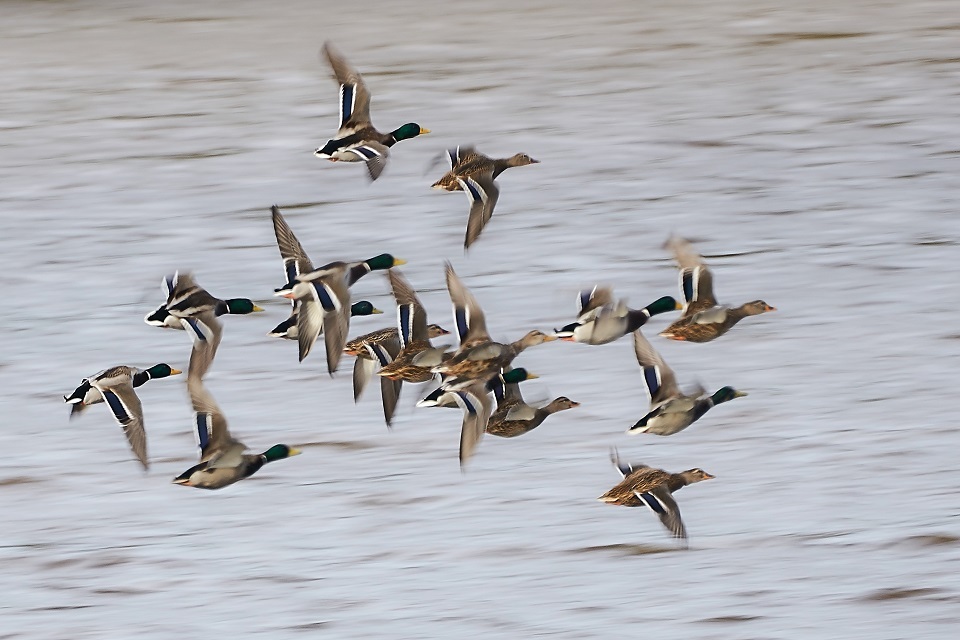
Image on this page shows a group of ducks flying. Credit: Jari Hytönen.