
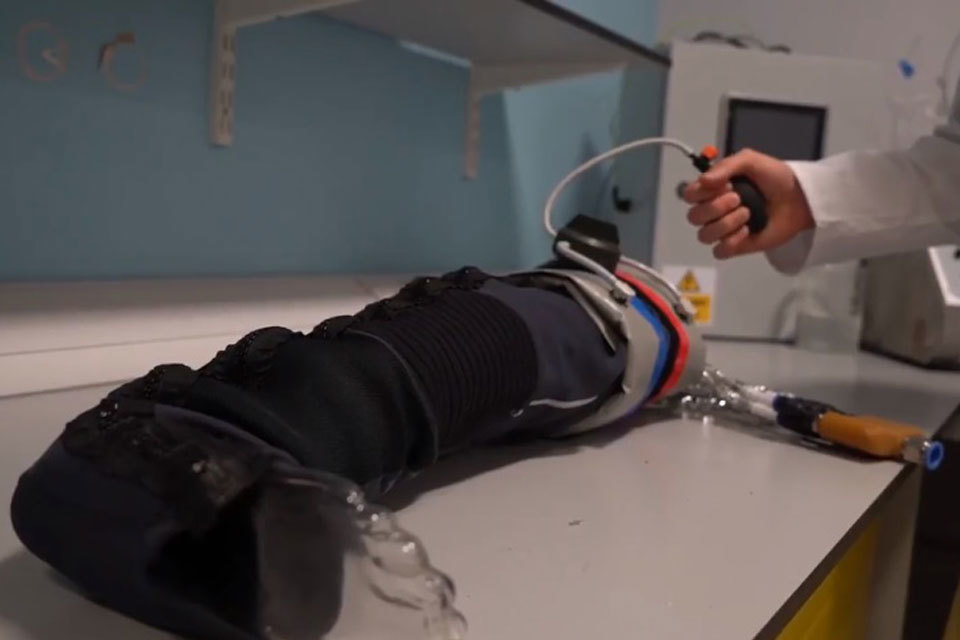
Biomedical engineers are pioneering a new technique for treating injured limbs which could reduce amputations after battlefield injuries.
The technique has been developed by researchers at the University of Strathclyde, Glasgow and funded by the Defence Science and Technology Laboratory (Dstl) through the Defence and Security Accelerator.
Created in response to the experiences of Iraq and Afghanistan, where improvised explosive devices caused traumatic injury, the three-stage approach is a brand-new technique that brings together kit that can be used in the field, with highly specialised solutions once the patient is evacuated to a hospital.
A novel tourniquet is applied to the limb, which applies pressure at different points, reducing pressure and damage to specific areas. A cooling ‘sock’ is then wrapped around the tissue, to preserve it from further damage until the casualty can be evacuated to a care facility. Once at a hospital, the limb is placed inside a protective ‘box’, which can sustain the area while doctors attempt repairs. The box has specially decontaminated air to reduce infection, and continually supplies the affected area with blood.
Weighing only five kilogrammes, the technology is specially designed for deployment on operations, and used by combat medics. The system could also be used in a non-military setting, for example natural disasters or remote locations.
Following successful trials, the system is set to be available commercially, and could one day form part of the medical kit in every frontline unit.
Dr Neal Smith, Capability Adviser, Medical Sciences, from Dstl, said:
While this technique may not be right for every injury, it is a hugely important innovation that could save the limbs of many more of those affected. It’s a fantastic example of where we work with academics to fund life-changing research which has been turned into a product to improve the quality of life of those injured in service.
Professor Terry Gourlay, Head of the Department of Biomedical Engineering at Strathclyde University, said:
We looked at every stage of the journey an injured soldier follows after injury to ensure our solution was designed specifically for them.
The system we have developed is essentially a life-support system for the limb which gives doctors precious time to attempt to repair damage while ensuring the safety of the patient.
Professor Gourlay’s team also pioneered the blood salvaging technique known as HemoSep, which allows blood lost in surgery to be transfused directly back to the patient, reducing the need to donated blood. A military version of the HemoSep project was also funded by Dstl.
Find out more about our Protecting Our People Programme.